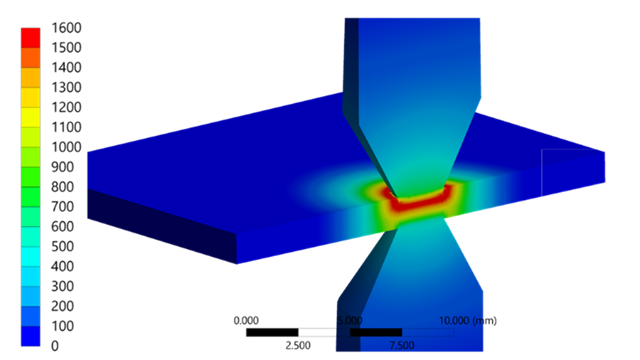
Numerical Simulation for Safe MRI Examinations

Medical implants in MRI environments pose unique safety challenges. One of the most critical concerns is heating caused by radiofrequency (RF) fields. This heating must be assessed reliably to rule out risks for patients. In this article, you will learn how numerical simulations can help evaluate these effects under realistic conditions and complement conventional testing methods in a targeted way.

Summary

  • Medical implants can heat up during MRI examinations due to radiofrequency fields, making reliable safety assessment essential for patient protection.
  • Established standards such as ASTM F2182 and ISO/TS 10974 provide validated test procedures, but they only partially reflect real anatomical and physiological conditions.
  • Electromagnetic and thermal simulations developed at OTH Amberg-Weiden offer more realistic evaluations, help identify worst-case scenarios early, and can streamline testing and regulatory approval processes.

RF Heating: Physical Background and Relevance

In MRI (magnetic resonance imaging), hydrogen nuclei are excited by radiofrequency pulses whose frequency depends on the strength of the magnetic field. Typical clinical systems operate at 64 MHz (1.5 Tesla) or 128 MHz (3 Tesla). To achieve higher image resolution, so called ultra-high-field (UHF) systems are increasingly being developed. However, these are currently used primarily in research settings. Due to the substantial acquisition and operating costs, as well as extensive infrastructure requirements, their use in clinical practice remains largely limited to a small number of specialized medical centers.

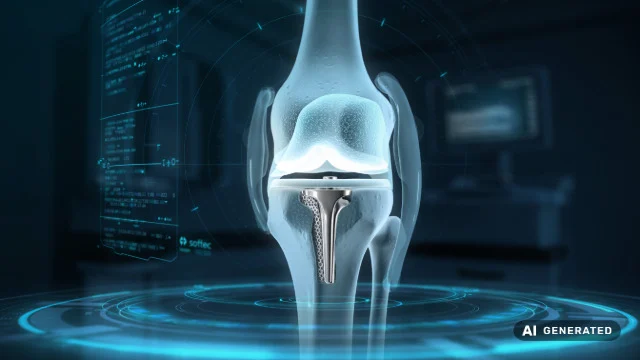
Conductive implants can absorb these RF fields and act like antennas. Depending on their length, geometry, and orientation, localized increases in electric field strength can occur, particularly at the ends of implants. These effects can lead to significant heating of surrounding tissue and must therefore be evaluated carefully.

Standard Tests and Their Practical Limitations

Today, RF-induced heating is typically evaluated according to ASTM F2182 for passive implants such as orthopedic plates or artificial joint replacements. For active implants with a power supply, such as pacemakers, ISO/TS 10974 also applies. In these tests, the implant is placed in a tissue-equivalent phantom and temperature is measured at predefined points over a specified period, for example 360 seconds.

Although this method is well established, it represents real-world conditions only to a limited extent. Measurements are taken at discrete locations, tissue is assumed to be homogeneous, and physiological effects such as perfusion are not considered. In addition, MRI systems and specialized testing laboratories are often heavily booked, which can delay development and regulatory approval processes. In the worst-case scenario, testing may not be possible at all, forcing implant manufacturers to classify a potentially safe implant as “MR unsafe,” thereby unnecessarily restricting patient access to an important diagnostic procedure.

Tip: Let's Simulate – Implant Heating

Would you like to learn how these simulation approaches can be implemented in practice? In the CADFEM training "HF Simulation with Ansys HFSS" or in the Let's Simulate episode "Let's Simulate - Implant Heating", we show how electromagnetic simulations can be used specifically to assess MR safety.

Info & registration

rf-simulation-with-ansys-hfss-18260

Research at OTH Amberg-Weiden: Simulation as a Complementary Approach

Researchers at OTH Amberg-Weiden are investigating how electromagnetic and thermal simulations can complement these tests effectively. 

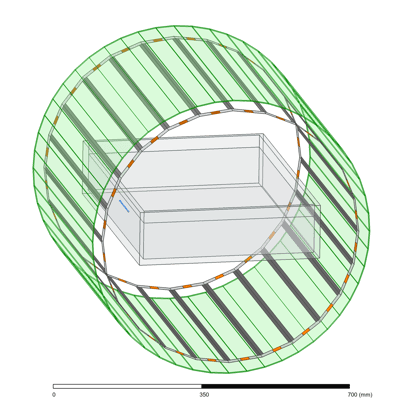
Birdcage coil for RF excitation with an ASTM F2182 phantom setup and calibration rod in Ansys HFSS. | © Joshua Igl, OTH Amberg-Weiden

Birdcage coil for RF excitation with an ASTM F2182 phantom setup and calibration rod in Ansys HFSS. | © Joshua Igl, OTH Amberg-Weiden

In these studies, standardized test configurations are recreated digitally. Suitable coil systems, known as birdcage coils, are developed in Ansys HFSS and tuned to the required operating frequency. The objects under investigation are placed inside the coil within a tissue-equivalent model and analyzed with respect to electric field distributions. The resulting power losses can then be transferred to Ansys Icepak to determine the associated temperature changes. Transient simulations are used for this purpose.

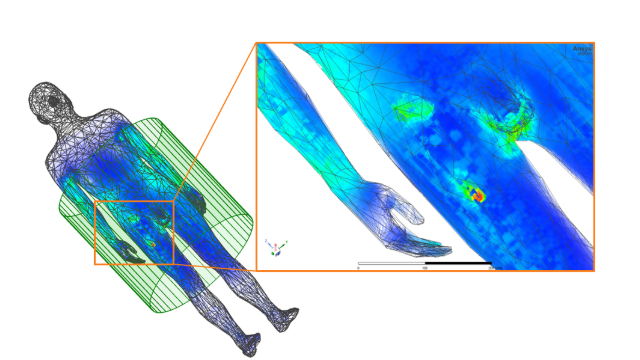
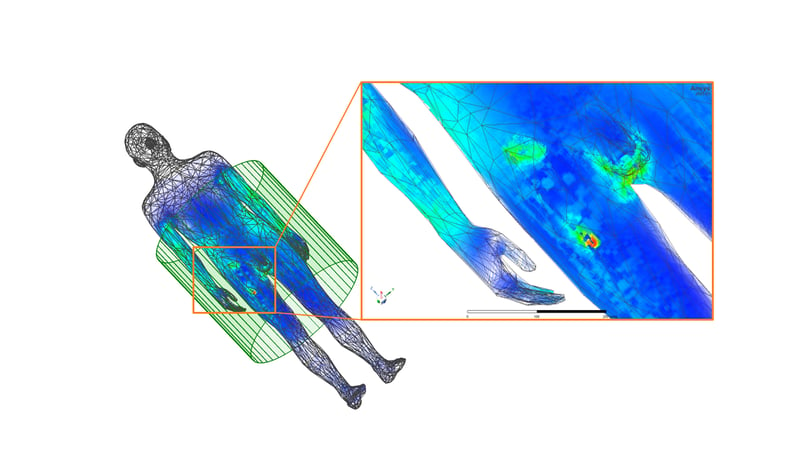
In addition to conventional phantoms, which generally mimic the properties of homogeneous muscle tissue using anatomically non-specific rectangular Plexiglas containers, simulations can also incorporate human body models. The detailed representation of surrounding tissue properties and anatomically accurate geometries enables a more realistic prediction of temperature changes.

Benefits for Manufacturers, Regulators, and Patients

Unlike experimental testing, which captures only a limited number of discrete measurement points, simulation provides a complete analysis of the entire examination volume. Although purely numerical testing is not yet included in current standards, simulations already make it possible to identify worst-case scenarios early and systematically, adapt experimental test setups accordingly, and accelerate the overall process. This can simplify regulatory approval for manufacturers and ultimately provide more patients with access to important diagnostic procedures.

Transient thermal simulation showing the RF-induced heat hotspot at the end of an orthopedic hip implant in a homogeneous body model. | © Joshua Igl, OTH Amberg-Weiden


Transient thermal simulation showing the RF-induced heat hotspot at the end of an orthopedic hip implant in a homogeneous body model. | © Joshua Igl, OTH Amberg-Weiden

Continued research using more detailed models is expected to make testing less conservative in the future, support the development of new mitigation strategies, and enable even more patients to benefit from safe MRI diagnostics. The next generation of UHF systems is increasing the demand for testing and introduces new challenges, including significantly shorter wavelengths. Simulation plays a key role in addressing these challenges. This makes it particularly important to continue improving the efficiency of testing processes. Ideally, fully simulation-based testing procedures could eventually be incorporated into standards, reducing the effort required for testing even further.

Training on the Topic

Portrait_Joshua_Igl _400x270

Author

Joshua Igl

OTH Amberg-Weiden

j.igl@oth-aw.de

Portrait_JNE_Blog

Author

Dr.-Ing. Jörg Neumeyer

CAE Engineer

+49 (0)8092 7005-766
 jneumeyer@cadfem.de 

Portrait_KKU_Blog

Editorial

Klaus Kuboth

CADFEM Germany GmbH

+49 (0)8092 7005-279
kkuboth@cadfem.de


CADFEM_Navy_RGB


Über „Firmenname“

Lorem ipsum dolor sit amet, consetetur sadipscing elitr, sed diam nonumy eirmod tempor invidunt ut labore et dolore magna aliquyam erat, sed diam voluptua. At vero eos et accusam et justo duo dolores et ea rebum. Stet clita kasd gubergren, no sea takimata sanctus est Lorem ipsum dolor sit amet. Lorem ipsum dolor sit amet, consetetur sadipscing elitr, sed diam nonumy eirmod tempor invidunt ut labore et dolore magna aliquyam erat, sed diam voluptua. At vero eos et accusam et justo duo dolores et ea rebum. Stet clita kasd gubergren, no sea takimata sanctus est Lorem ipsum dolor sit amet. Lorem ipsum dolor sit amet, consetetur sadipscing elitr, sed diam nonumy eirmod tempor invidunt ut labore et dolore magna aliquyam erat, sed diam voluptua. 

You may also find these articles of interest.