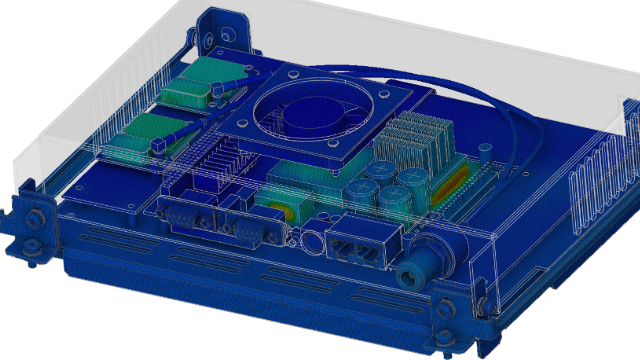
NVIDIA Omniverse: The Platform That Unifies Engineering, Simulation, AI, and Operations Within a Single Digital Ecosystem

NVIDIA Omniverse is rapidly becoming the key platform for digital twins and modern simulation processes. By connecting CAD, CAE, and AI workflows, its open OpenUSD architecture enables a continuous, real time representation of complex products and systems. As a result, companies gain a scalable toolbox for collaborative engineering, automated simulations, and industrial metaverse applications. In this article, you will learn how to improve your engineering processes using NVIDIA Omniverse.

Summary

  • Omniverse links CAD, physics based field simulations, and IoT data in a consistent OpenUSD scene. It enables interdisciplinary collaboration and physically grounded decision making.

  • The modular architecture of Omniverse – with connectors, extensions, apps, and cloud services – provides a flexible basis for GPU accelerated simulation and AI driven automation. Combined with PyAnsys, the Python based interface to all Ansys solvers and post processing capabilities, this forms true end to end workflows: fully automated, entirely reproducible, and seamlessly integrated from simulation to USD based visualization.

  • Concrete industrial applications: Examples from Krones, SICK, and Schaeffler illustrate how virtual commissioning, digital production twins, or virtual sensing deliver real economic value and pave the way toward the industrial metaverse.

In many companies, simulation has already become standard practice, yet thinking is still often limited to a toolbox mindset: each task is solved with its own specialized tool – sequentially, separately, and within isolated departments. But the challenges of the future are interconnected: products interact with their environments, systems connect to other systems, and processes depend on real operating data. Classical CAE and CAD tools were never designed for this – they operate in isolation, rely on proprietary structures, and work sequentially.

NVIDIA Omniverse fundamentally changes this paradigm. The platform creates a continuous, open, and connected engineering ecosystem that brings together simulation, AI, visualization, automation, and real world data sources in a shared digital space.

Omniverse is therefore less a tool than an infrastructure for the industrial metaverse – a space where products, machines, plants, factories, cities, or logistics networks exist as living, consistently interconnected digital twins. They can be simulated, validated, and operated using physics, AI, and connected data. CADFEM integrates these capabilities with established CAE workflows and makes them accessible for engineering.

Strategic Partnerships as a Trusted Foundation

The close collaboration between Synopsys and NVIDIA shows that simulation, AI, and GPU computing are strategically converging. The investment by NVIDIA in  Synopsys underscores this direction and provides companies with planning certainty. Through their joint blueprint, and with partners such as CADFEM, Microsoft, and SoftServe, Omniverse is evolving into a scalable engineering platform that connects cloud infrastructures with physics based simulation.

Questions for Our Experts

Do you have questions about the practical application of simulation, digital twins, or Omniverse workflows? Markus Meingast and our team of experts are available for a personal technical consultation.

Request a consultation

MME

Architecture and Key Technologies of Omniverse

Technically, Omniverse is based on a modular, microservice oriented architecture. Services for visualization, physics simulation, collaboration, or streaming can be operated locally, on premises, or in the cloud and scaled flexibly.

At the heart of Omniverse is OpenUSD, an open and high performance 3D data standard originally developed by Pixar. OpenUSD is not just a file format but a scene and data description with the following characteristics:

  • supports massive scenes with billions of elements

  • enables layering, variants, and parallel editing

  • connects geometry, materials, physics, semantics, and simulation

  • can be streamed live and versioned

  • is fully modular and independent of programming language or software

As a result, USD becomes the single source of truth in which CAD geometries, FEM fields, CFD flows, EM regions, robotics paths, IoT data, and AI annotations can coexist simultaneously.

Omnigraph: Visual, Node Based Workflow System

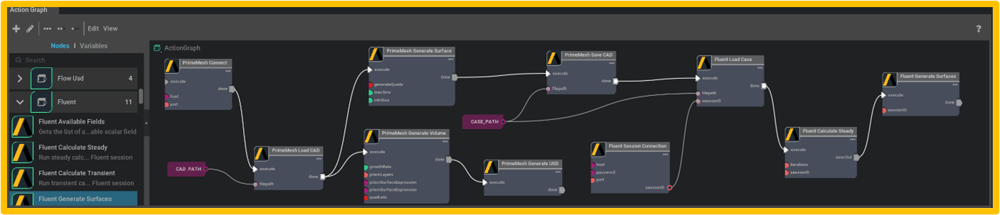
One of the central strengths of NVIDIA Omniverse lies not only in realtime visualization or the open USD data model but also in its ability to automate, orchestrate, and live link complex processes with the 3D scene. This is exactly where Omnigraph comes in – a visual, node based workflow system.

Omnigraph is based on representing workflows as graphs composed of nodes, edges, and execution logic that define how data flows through the graph in realtime. Each node represents a function, a data source, an operation, or an interface to external tools. This makes it possible to define even highly complex engineering processes in a clear structure and combine them without programming knowledge. At the same time, the system remains open for developers who want to add their own node types via Python or C++ extensions.

Blog_Omniverse_01

Example: Omnigraph for a Fluent workflow. | © CADFEM Germany GmbH

Opportunities for Design and Simulation Experts

For experienced users in design and simulation, three key benefits emerge:

  1. Realtime collaboration: Multiple disciplines – mechanics, fluid dynamics, electromagnetics, automation – work simultaneously on the same digital twin. Changes to geometry, boundary conditions, or scenarios become visible immediately, including the physical responses from the connected solver environments.

  2. Digital twins in operational context: Digital twins or reduced order models (ROMs) can run directly in Omniverse. Input streams come from time series data, edge devices, or IoT platforms; results such as temperature, stress, or velocity fields are shown as point clouds or projected fields in the scene. This transforms the simulation model into an operational decision support tool for maintenance, optimization, and virtual commissioning.

  3. Automated workflows with Omnigraph: Omnigraph enables no code workflows that control CAE processes – for example, launching a Fluent run, importing the results via PyDPF, and transferring them into OpenUSD.

Why Omniverse Is Valuable Regardless of a Customer’s Simulation Maturity

Even if a company already has advanced simulation capabilities, Omniverse solves challenges that classical CAE tools cannot address alone:

  • Data integration instead of data silos: CAD, CFD, FEM, EM, robotics, sensing – everything inside USD.

  • Multidisciplinary realtime collaboration: Teams work simultaneously on the same digital twin – no file exchanges, no media breaks.

  • Simulation + environment + operations: A simulation model typically does not know its environment or the real world. An Omniverse model does.

  • Cloud based scaling: On demand hardware utilization and elastic scaling via Kubernetes.

Practical Examples

Krones and the Drinktec Blueprint

Krones uses Omniverse and GPU accelerated CFD simulations to virtually represent filling processes and plant layouts. Sloshing effects can be visualized in detail and evaluated in highly realistic production environments. The drinktec blueprint shows how these approaches can be merged into a fully digital plant twin that connects planning, operations, and service and significantly increases process reliability. This enables Krones to guarantee plant performance in advance – for different bottle designs, contents, and other requirements.

Virtual Sensing at SICK and Production Twins at Schaeffler

SICK relies on virtual sensor development by simulating the behavior of optical systems and their environments in detail in Omniverse long before physical hardware exists. Schaeffler takes it a step further by creating digital representations of entire plants and manufacturing networks to manage material flows, capacity utilization, and energy efficiency through data driven insights. Decisions are based on a global production twin.

CADFEM as an Enabler for the Industrial Metaverse

Many companies are less interested in the core technology itself and more in identifying the right starting point. CADFEM analyzes existing CAD, CAE, and data landscapes, identifies suitable use cases, and develops pilot workflows such as GPU accelerated CFD post processing or digital twins. Building on this, a scalable roadmap is created that turns individual showcases into an integrated Omniverse platform.

While classical simulation programs remain indispensable, Omniverse forms the overarching platform that connects all data, models, AI mechanisms, and workflows into a coherent, interactive, and automatable engineering ecosystem. Omniverse is the missing link between simulation, AI, and real world operations. It transforms isolated tools into a unified platform for the future.

MME_rund

Autor

Markus Meingast

CADFEM Germany GmbH

+49 8092 / 7005-839
mmeingast@cadfem.de

Portrait_KKU_Blog

Redaktion

Klaus Kuboth

CADFEM Germany GmbH

+49 8092 / 7005-279
kkuboth@cadfem.de