Digital Twin for the Process Industry

From process simulation to AI-driven plant control: Physics-based digital twins make complex production processes transparent and provide the foundation for automated process optimization. The research project KIckBio at Technikum Laubholz (TLH) demonstrates how this works in practice using the example of microfibrillated cellulose (MFC).

Summary

  • Complex production processes in process engineering consist of numerous interconnected operations. Physics-based digital twins help make these interactions transparent and enable targeted analysis of key process parameters.
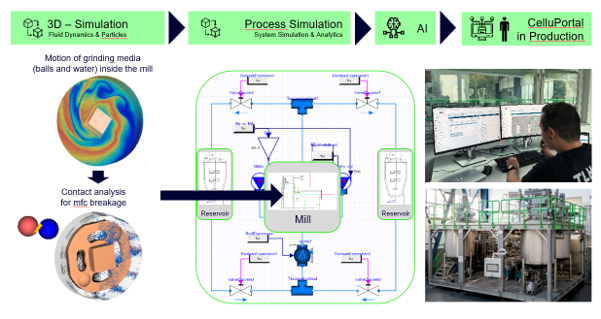
  • The combination of system simulation, CFD, and DEM makes it possible to represent material flows, plant behavior, and individual process steps within a single integrated model and analyze them through "what-if" scenarios.
  • Using the production of microfibrillated cellulose (MFC) as an example, the KIckBio project shows how simulation and digital twins can support process optimization and provide data for AI-based automated plant control.

How Can Manufacturing Processes Be Better Understood and Optimized?

Production processes in the chemical, pharmaceutical, food, and materials industries consist of a wide range of interconnected process steps. Fluid flow, mass transfer, mixing, particle size reduction, and heat transfer continuously influence one another and play a decisive role in determining product quality. As a result, plant operators and developers face the challenge of gaining a deeper understanding of process behavior in order to optimize and ultimately automate production systems.

Digital twins provide a critical foundation for this effort. These virtual representations of production systems combine physics-based system simulation models with 3D field simulations, allowing process behavior to be analyzed realistically. This makes it possible to identify and optimize key process parameters virtually during early development stages. An additional advantage is the ability to maintain production systems at an optimal operating level throughout their service life.

Digital Twins for Process Engineering

Digital twins are already well established across various industries, including energy generation and mechanical and plant engineering. The same benefits can be leveraged in process engineering to model and analyze complete production processes virtually. In practical applications, this means representing material and energy flows, equipment behavior, and interactions between individual process steps within a single integrated model.

By combining process and system simulation with Computational Fluid Dynamics (CFD) and the Discrete Element Method (DEM), physics-based models are created that not only describe individual components but also provide a comprehensive understanding of overall system behavior.

This approach helps answer important questions:

  • How do changes in raw material quality affect the overall process?
  • Which operating parameters have the greatest influence on product quality?
  • How can energy losses be minimized?
  • Which control variables are critical for automated process control?
  • How can AI algorithms be trained safely and effectively?

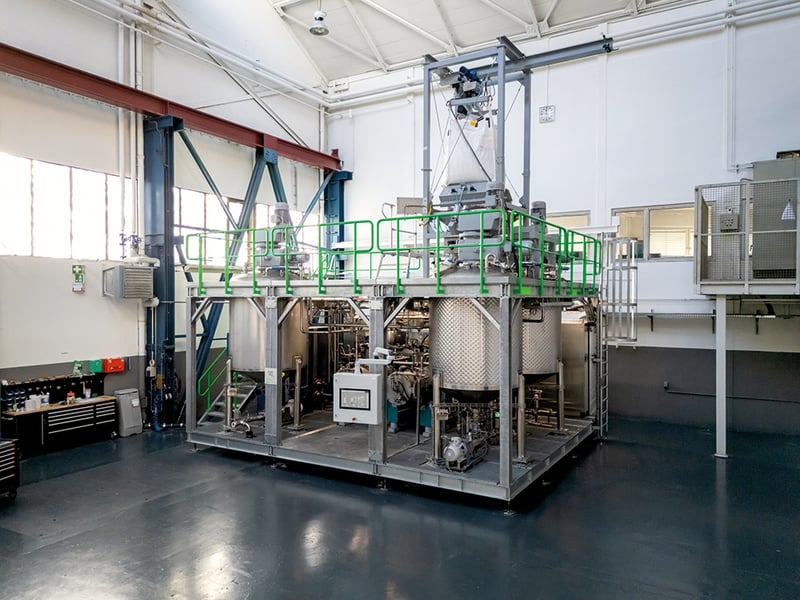
The project’s goal was to build a fully automated pilot plant to produce microfibrillated cellulose (MFC). In the second phase of the project, the plant’s efficiency was to be improved using a digital twin and AI-based process optimization. | © Technikum Laubholz

The project’s goal was to build a fully automated pilot plant to produce microfibrillated cellulose (MFC). In the second phase of the project, the plant’s efficiency was to be improved using a digital twin and AI-based process optimization. | © Technikum Laubholz

From 3D Simulation Model to Physics-Based Digital Twin

While traditional process design typically validates technical feasibility only at selected operating points and often includes conservative safety margins, a physics-based digital twin captures process behavior at the level of physical detail required for each application. Model development follows a step-by-step workflow, progressing from 3D field simulation through model order reduction to system simulation:

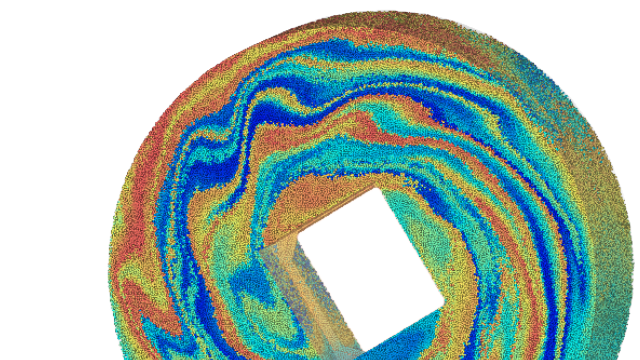
  • Detailed simulations are first used to analyze physical phenomena such as fluid flow, particle motion, mixing processes, and heat transfer.
  • Reduced-order models are then derived and integrated into the system simulation.
  • The result is a digital twin that combines physical accuracy with high computational efficiency, making it suitable for process optimization, control applications, and AI-based solutions.

This methodology can be transferred to a wide range of process industries, including food, pharmaceuticals, chemicals, and bio-based materials, as demonstrated in the following example.

The fully automated pilot plant | © Technikum Laubholz

The fully automated pilot plant | © Technikum Laubholz

Microfibrillated Cellulose as a Practical Example

The KIckBio research project at Technikum Laubholz illustrates how this approach can be implemented in practice. The project's objective was to develop a fully automated and economically optimized production process for microfibrillated cellulose (MFC). MFC is considered a sustainable alternative to many petrochemical additives and offers potential applications in cosmetics, food products, and advanced materials.

The project focused not only on developing the production facility itself but also on creating a physics-based digital twin of the entire manufacturing process. The complete material circulation[E(3.1] between tanks, pumping systems, and the ball mill was modeled within a system simulation environment, while the milling process was integrated using CFD and DEM simulations.

The resulting simulation data then served as training data for AI using easily executable "what-if" studies. The role of the AI was to adjust process and system parameters so that the physical production plant, the real-world counterpart of the digital twin, could consistently produce microfibrillated cellulose at the required quality Level within a fully automated manufacturing environment. This represented an important step toward industrialization and commercialization.

The "what-if" scenarios also provide extensive opportunities to accelerate knowledge development within the organization and support a deeper understanding of plant behavior. They are equally valuable for investigating operational edge cases and unusual process conditions.

Conclusion: One Step Closer to the Connected Process Industry

The production of microfibrillated cellulose highlights the wide range of challenges faced by the process industry. Complex production systems must be understood, optimized, and increasingly automated. Digital twins provide the necessary transparency by combining system simulation with CFD, DEM, and other physics-based models to create a comprehensive representation of production processes.

The KIckBio project demonstrates how digital twins can be developed for process engineering applications to establish the foundation for plant design, process optimization, AI-based applications, and, ultimately, fully automated production with dynamically optimized process parameters. The methods used are not limited to the production of microfibrillated cellulose but can also be applied in the food, pharmaceutical, chemical, and materials industries. https://technikumlaubholz.de/kickbio/kickbio-projektpartner-cadfem/

Watch the video now to find out more about the project:

Technikum Laubholz (TLH)

Founded in 2020 on the initiative of the Baden-Württemberg Ministry for Rural Areas, Agriculture and Consumer Protection, Technikum Laubholz (TLH) in Göppingen promotes the transition toward sustainable and future-oriented industrial solutions. Its mission is to unlock the potential of hardwood resources and transform them into commercially viable applications.

At TLH, interdisciplinary teams work to transfer research into industrial practice quickly, innovatively, and effectively. The organization's focus areas include sustainable materials, biotechnology, plant-based polymers, and the integration of AI and automation technologies. Through these activities, TLH is helping establish wood as a key raw material for the industries of the future. https://technikumlaubholz.de/en/kick-bio/

Portrait_GFR_Blog

Author

Gerhard Friederici

CADFEM Germany GmbH

+49 8092 7005 883
gfriederici@cadfem.de

Portrait_CAB_Blog

Author

Christian Abramowski

CADFEM Germany GmbH

+49 8092 7005 765
cabramowski@cadfem.de

Portrait_KKU_Blog

Editorial

Klaus Kuboth

CADFEM Germany GmbH

+49 8092 7005 279
kkuboth@cadfem.de