How Does Simulation Support Bridge Assessment and Rehabilitation?
Dr.-Ing. Roger Schlegel
13.10.2026
How Simulations Reveal the Need for Bridge Rehabilitation
Infrastructure assets such as bridges are usually safety-critical and exposed to a wide range of loads. Detecting the need for rehabilitation at an early stage and initiating appropriate measures require reliable assessments, especially for older structures. At the same time, resources can be conserved if a structure’s functionality can be verified and reconstruction avoided. Engineers at Geodynardo carry out such analyses using Ansys.
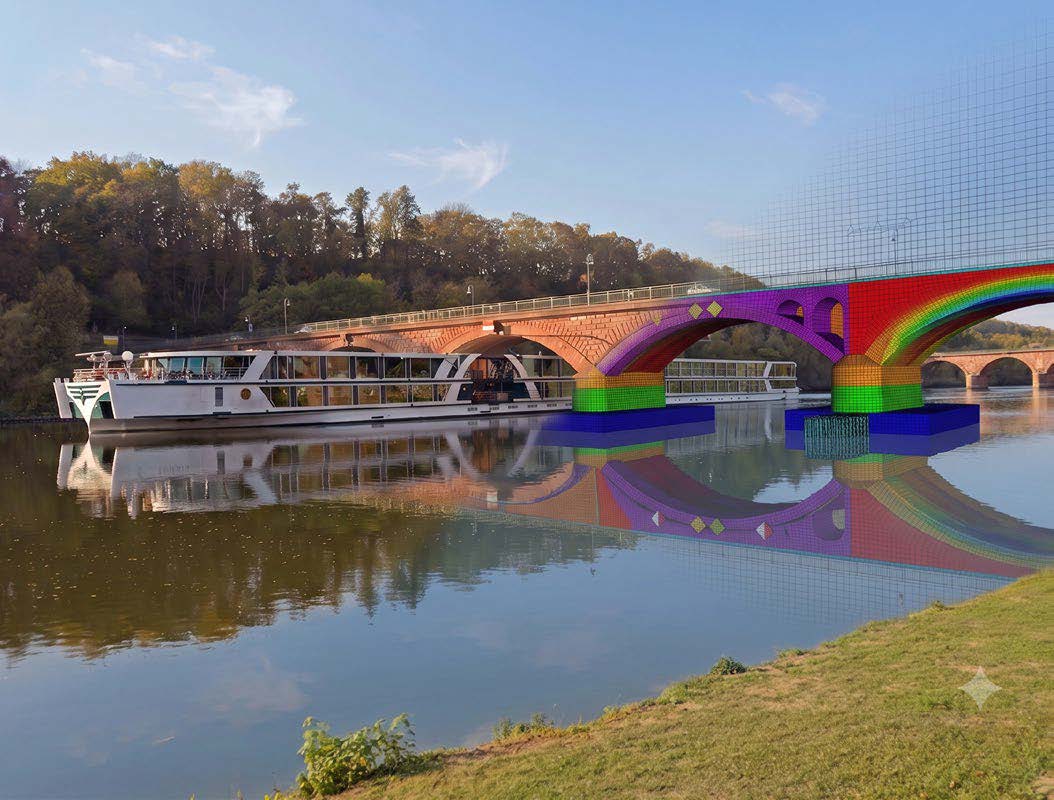
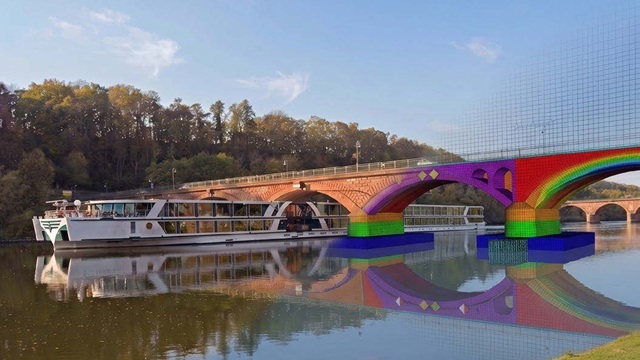
Mainbrücke Marktheidenfeld | © Adobe Stock; CADFEM/Be:Lateral, Geodynardo
Summary
-
Geodynardo engineers leverage advanced Ansys-based simulation technologies to accurately assess the structural integrity and serviceability of existing infrastructure, enabling targeted and cost-effective rehabilitation strategies.
-
Using the Main Bridge in Marktheidenfeld as an example, dynamic impact simulations demonstrated that more realistic structural analyses can reveal additional load-bearing reserves beyond those identified through conventional engineering methods.
-
By calibrating digital models with real-world monitoring data, infrastructure owners can continuously evaluate asset condition, predict future performance, and optimize maintenance and strengthening measures over the entire lifecycle of a structure.
Simulation-based investigations of existing structures regarding load-bearing capacity and serviceability are a core area of expertise at Geodynardo GmbH in Weimar. Compared with traditional engineering models commonly used in structural engineering, these analyses offer significant advantages. Entire structures or representative sub-models can be analyzed, allowing interactions between different structural components as well as dynamic or exceptional loading scenarios, such as earthquakes, impacts, or fire, to be considered. This enables rehabilitation and strengthening measures to be planned and implemented in a highly targeted manner. Two examples illustrate this approach:
Case Study: River Main Bridge in Marktheidenfeld, Germany
For a realistic assessment of the load-bearing capacity of the Main bridge in Marktheidenfeld under ship impact, it is essential not only to consider the three-dimensional structural behavior but also to simulate the dynamic response of the structure. Figure 1 shows the complete FE model of the bridge, including its different structural components and materials. A transient dynamic analysis goes beyond simplified quasi-static calculations and reveals additional load reserves. The chart (Fig. 2) shows the temporal evolution of the reaction forces resulting from a frontal ship impact on the second pier of the bridge.
Fig. 1: Vertical relative displacements caused by the filling of the canal bridge with water. | © Geodynardo
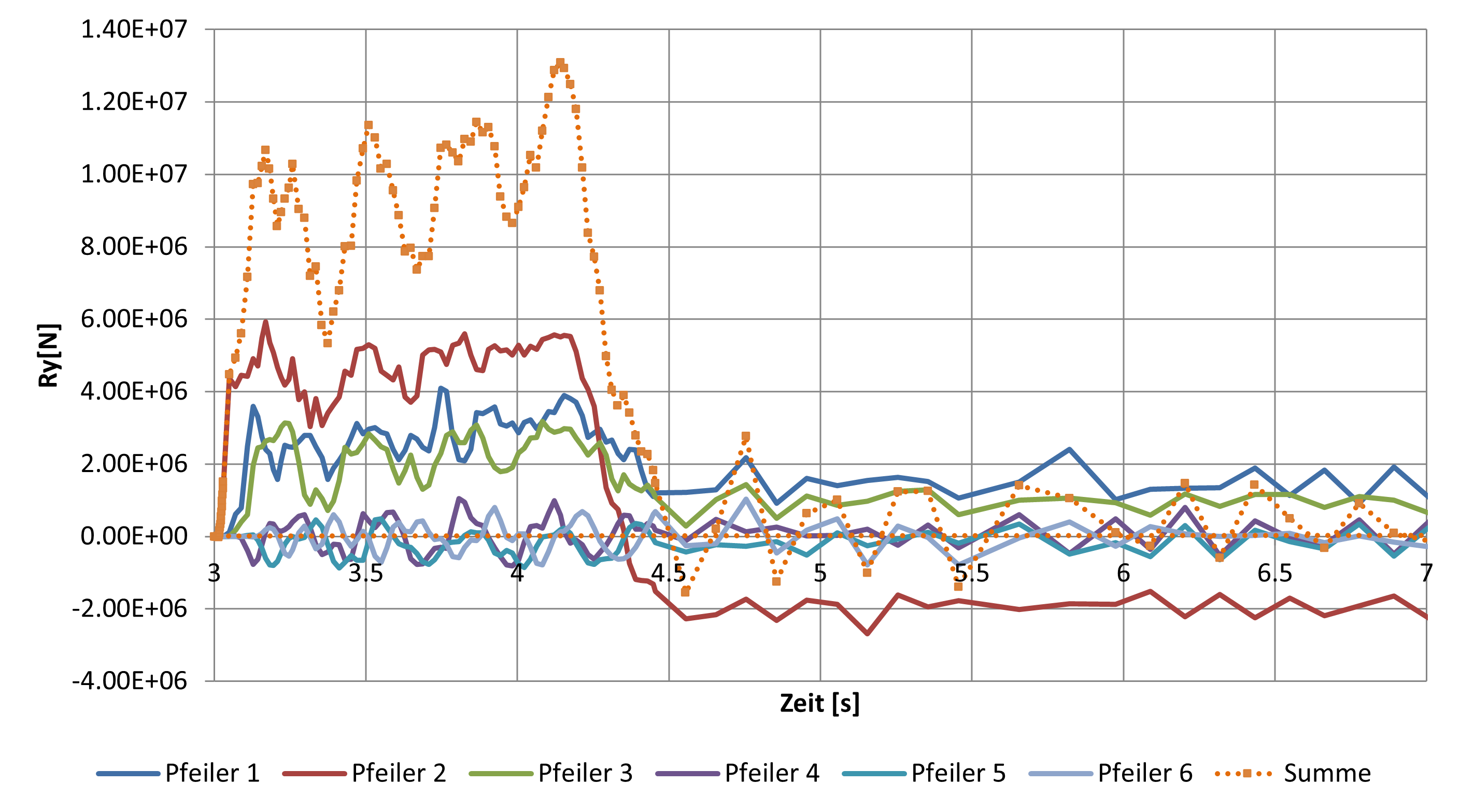
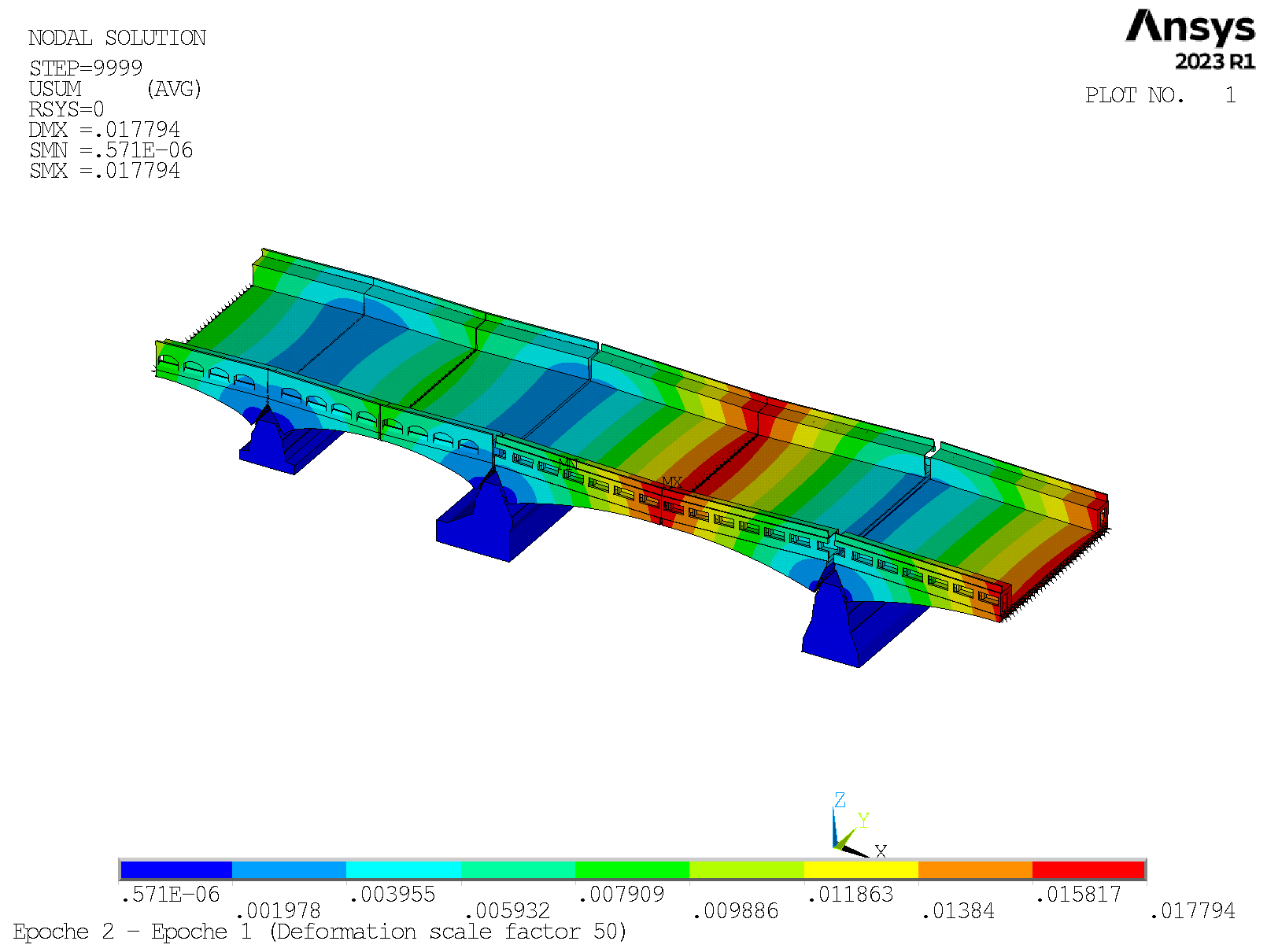
Fig. 2: Model calibration by comparing the deformations of the simulation model with the measured values from the structural monitoring system. | © Geodynardo
Presentation: Simulation-based Assessment of Durability, Load-bearing Capacity, & Reliability of Traffic Infrastructure
Speaker: Dr.-Ing. Roger Schlegel, CEO, Geodynardo GmbH
Join now: CADFEM World Conference 2026, October, 20.–22., 2026, Darmstadt, Germany

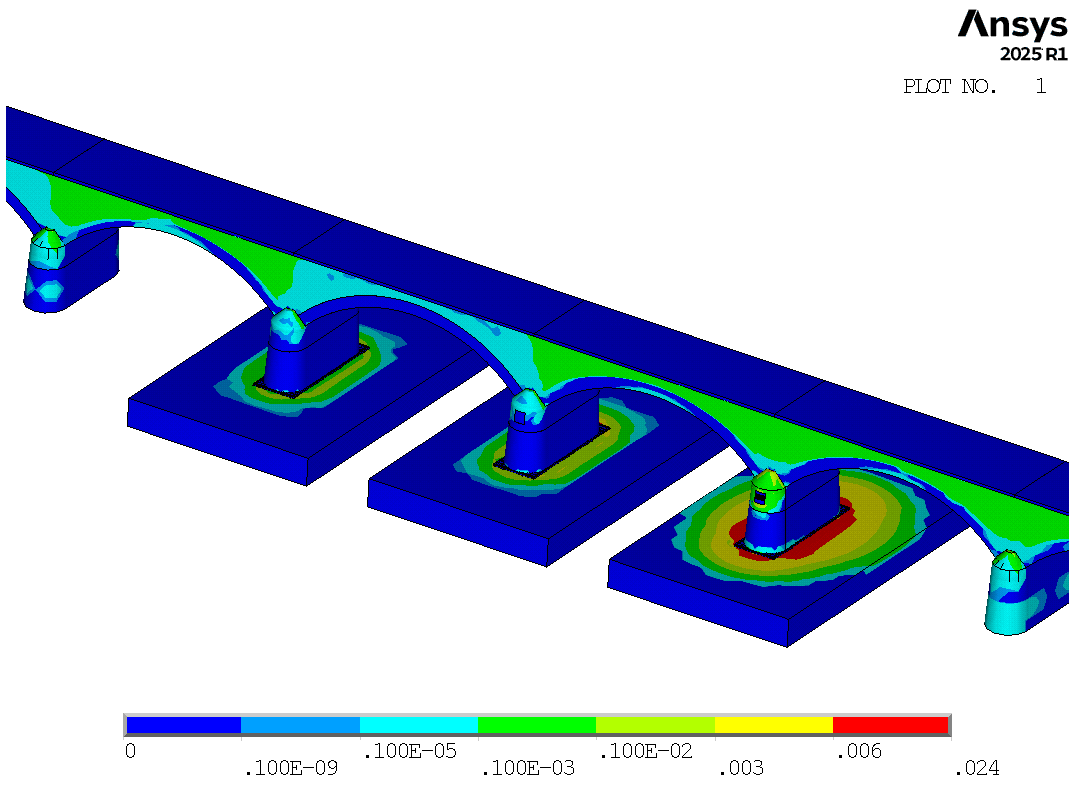
The structural response is clearly visible: the maximum reaction force at pier 2 does not coincide with the peak load amplitude. Instead, it occurs at the end of the first impulse phase, which exhibits a significantly steeper gradient. The simulation also shows the plastic strains at the end of the impact event. It becomes evident that the permanent deformations, approximately 5 mm at pier 2 and 1.5 mm at pier 3, are primarily caused by plastic strains in the subsoil.
By simulating ship impact dynamically using the full model of the River Main bridge in Marktheidenfeld, Germany, additional load reserves can be identified, enabling a realistic assessment of the serviceability and load-bearing capacity of the existing structure.
Structural Health Monitoring of a Reinforced Concrete Bridge
A simulation model developed by Geodynardo enables the condition of a canal bridge with three-hinged reinforced concrete arches, as well as its historic bearings and joints, to be monitored throughout the year. Figure 3 shows the structural deformations based on the three-dimensional simulation model, which has been calibrated using on-site measurement data collected over the course of a year. In addition to self-weight and water loading, seasonal temperature variations are also incorporated into the model.

Fig. 3: Head-on collision with pier 2: History of the reaction forces on the pier. | © Geodynardo
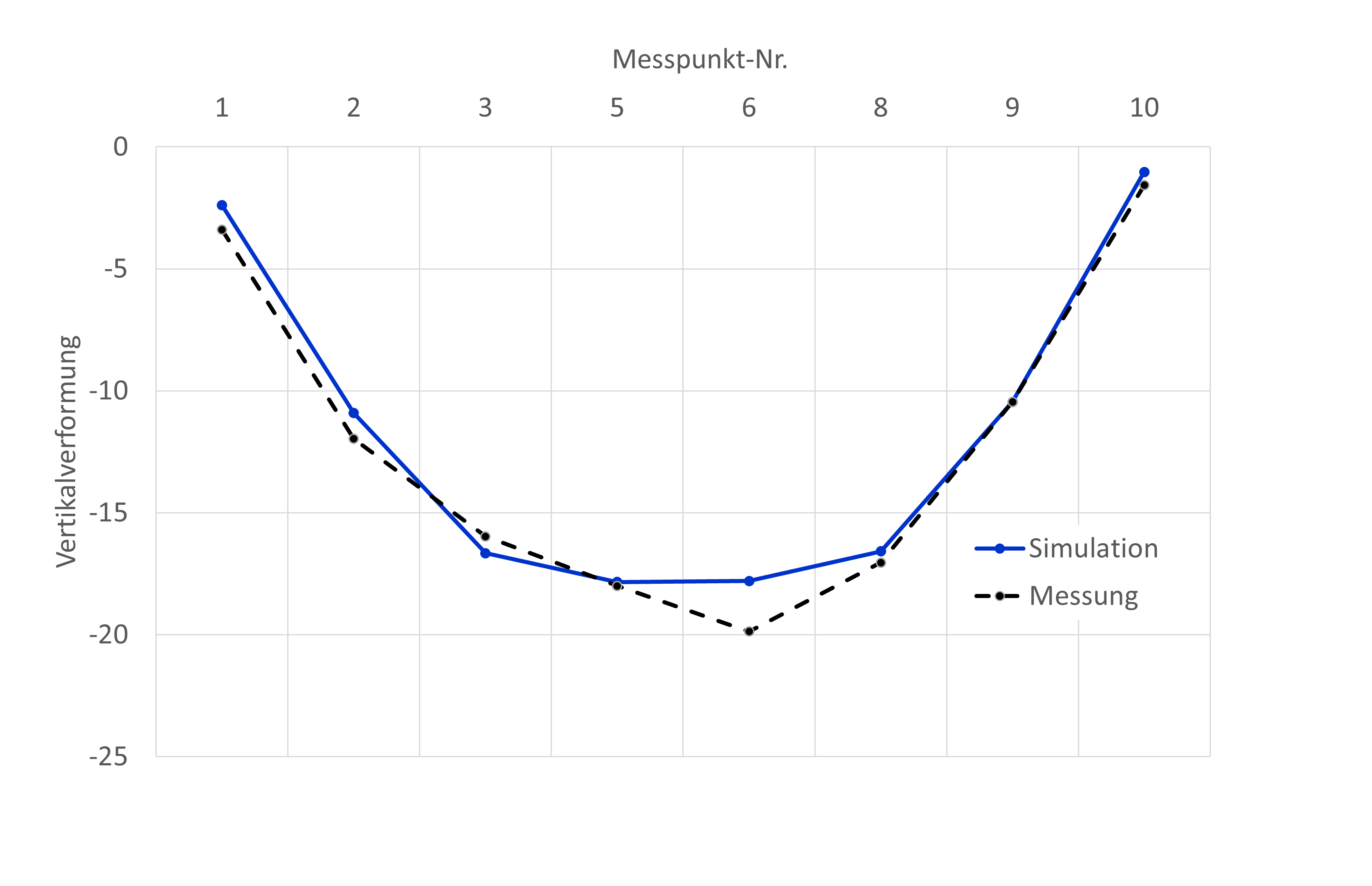
Fig. 4: Plastic strains EPPL_EQV at the end of the impact process. | © Geodynardo

On the one hand, the model allows new measurement data to be evaluated and their impact on the structural stress state to be determined. On the other hand, the calibrated model makes it possible to predict further seasonal scenarios, analyze appropriate maintenance strategies, and derive targeted strengthening measures for the structure in service.
ABOUT GEODYNARDO
Geodynardo GmbH, based in Weimar, Germany, is an engineering and software development company. Its focus lies on consulting and computational services for complex challenges in geotechnics and structural engineering, as well as stochastic analyses and numerical simulations. www.geodynardo.eu
Author
Dr.-Ing. Roger Schlegel
Geodynardo GmbH
CEO