Last-Mile Satellite Propulsion: Enabling Precise Orbit Positioning
Alexander Kunz
20.02.2026
Using Simulation to Develop an Innovative Rocket Propulsion System
Launch vehicles can transport up to 100 satellites into space at once. Once deployed,each satellite still needs to reach its designated operational position. Thisfinal step is enabled by the special propulsion systems developed by theAustrian start‑up GATE Space. For their development work, GATE Space relies onphysical prototypes and Ansys‑based virtual models.
Summary
- With its patented propulsion technology, the start-up GATE Space transports satellites to their deployment locations in space.
- Subsequent corrections during operation are impossible. That is why the system is validated through intensive real-world testing and comprehensive simulations with Ansys. CADFEM is the industry partner for the simulations.
- GATE Space's first mission in 2026 is the starting point for further projects to shape mobility in space. The start-up from Lower Austria and Vienna also wants to advance this with simulation.
The strategic importance of satellite technology for Europe’s security and defense capabilities is growing rapidly. As satellites form a key part of critical infrastructure, the European Space Agency (ESA) actively supports initiatives, projects, and companies such as the Lower Austria and Vienna based start up GATE Space. Its patented green propulsion technology for repositioning and maneuvering satellites will enter service in 2026 for the very first time – in the very environment it was designed for: outer space.
And once there, it must work flawlessly from the start. The investments made by satellite manufacturers and space companies in such missions are enormous. And in orbit, intervention or adjustments during operation are simply impossible.
“We know our system will work. After all, we tested complete prototypes extensively on the ground and, in parallel, anticipated all conceivable scenarios through countless simulations,” says Moritz Novak, CEO and founder of GATE Space.

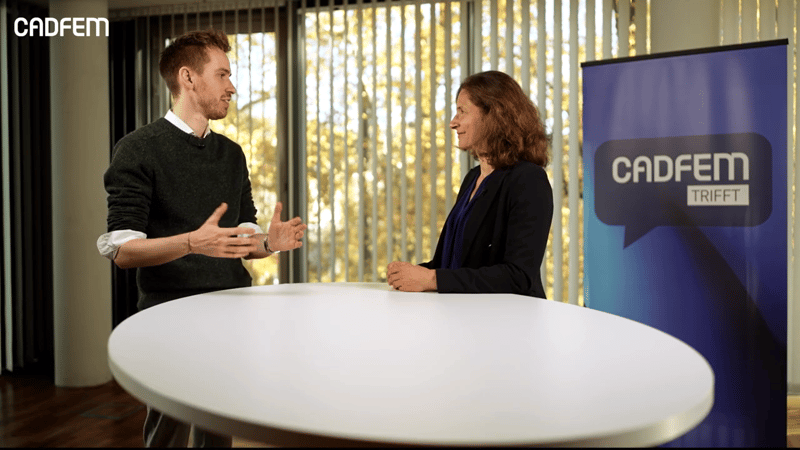
Founder and CEO Moritz Novak talks about the importance of simulations at GATE Space in an interview with Irene Reichl from CADFEM Austria. | © CADFEM
Discover the Ansys Startup-Program of CADFEM
Mobility in New Dimensions
With this type of mobility, Moritz Novak and his team are breaking new ground. To explain their purpose, he turns to a familiar example: It is the principle of a city bus that brings passengers to a stop from which they can continue on their own to reach their final destination. At GATE Space, the “city” is outer space, the “bus” is the launch vehicle, and the “passengers” are the satellites that still need to reach their individual target orbits.
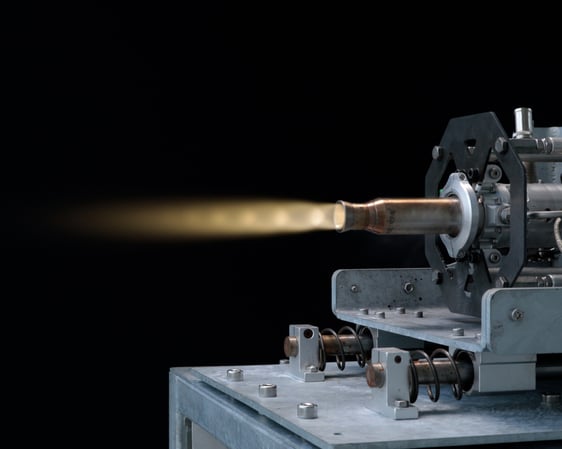
This “last mile” – repositioning satellites in space – has long been considered a particularly difficult maneuver. GATE Space closes this gap with its innovative propulsion system, enabling satellites to reach their optimal orbit in less than a day. It is based on small rocket engines powered by ethane and nitrous oxide. The gases are injected into a combustion chamber through a patented injector and ignited. The result is a flame up to two meters long that generates thrust in the intended direction.

GATE Space's rocket engines transport satellites to their destination. The patented injector plays an important role in this process. | © GATE Space
Maximum Reliability Across Countless Scenarios
The propulsion system is the first of its kind and has been patented by GATE Space. As is typical for disruptive technologies, there is little prior experience to draw on – yet there is a vast number of possible load scenarios it must withstand. Add to this the high customer investment and the corresponding low tolerance for risk, as well as the inability to make last minute corrections in orbit.
How, then, did GATE Space manage to turn an idea into an innovation that works with 100% reliability under such demanding conditions? When asked, Moritz Novak answers with one word: “Teamwork.” He considers the close interdisciplinary collaboration between internal and external experts from different fields a key factor in the success of such a venture.
The other key factor: modern development methods.
Our system will work. We have tested it extensively and anticipated all scenarios in countless simulations.”
As Is Analysis on the Test Bench and What If Scenarios on the Computer
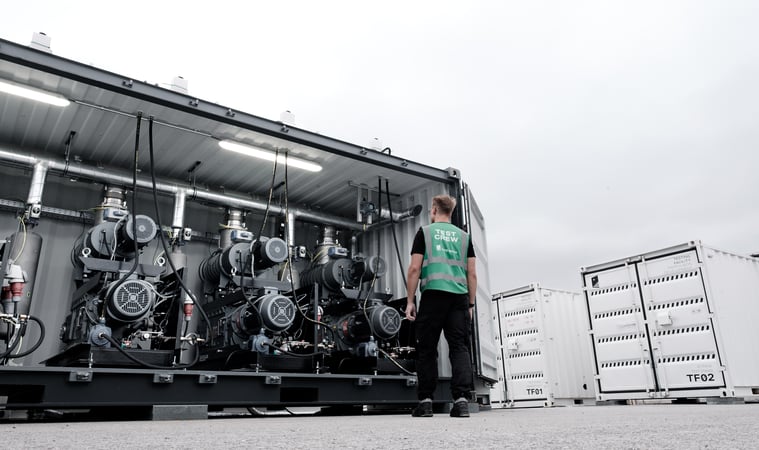
The GATE Space team relies on rapid prototyping and simulation for product development. “We build highly accurate prototypes, which we test intensively – all the way to destruction – on our own test facility. This rapid prototyping gives us fast and reliable feedback,” says Moritz Novak. “The beauty of it is: when we see with our own eyes that the hardware works, it gives us certainty, because calculation errors are excluded. And if it doesn’t work, it is honest feedback that the product wasn’t designed well enough.”
And simulation? “Simulations are indispensable for our approach because they allow us to evaluate different designs and scenarios cost effectively and quickly using virtual prototypes. This enables us to precisely anticipate our products’ performance and design the prototypes optimally right from the start,” he explains.
During their time as students at TU Wien, he and several team members became familiar with the Ansys software and CADFEM’s technical support. Back then, they built a student team focused on satellite and rocket propulsion development. The simulation expertise gained and the close connection with CADFEM continue to benefit GATE Space today through the Ansys Startup Program.

The rocket engines are comprehensively tested under a wide range of loads on the GATE Space test bench. Decisions are made based on the test results and the Ansys simulation results. | © GATE Space
A Broad Simulation Spectrum
The range of simulation applications is wide, with structural mechanics at the core. During launch, the aggregated satellites – including the GATE Space propulsion system – are subjected to massive forces and vibrations that the structure must withstand. These loads are analyzed in detail beforehand, and the required design measures are implemented in the physical prototypes. If a satellite or even a single component – such as the propulsion system – fails during launch, a domino effect (“pairing”) can occur, taking other satellites with it.
Smaller structural elements are also simulated, such as the injector seals. In addition to structural mechanics, flow phenomena are analyzed as well, for example the behavior of fluids in the tanks or in the injection system.
Vision
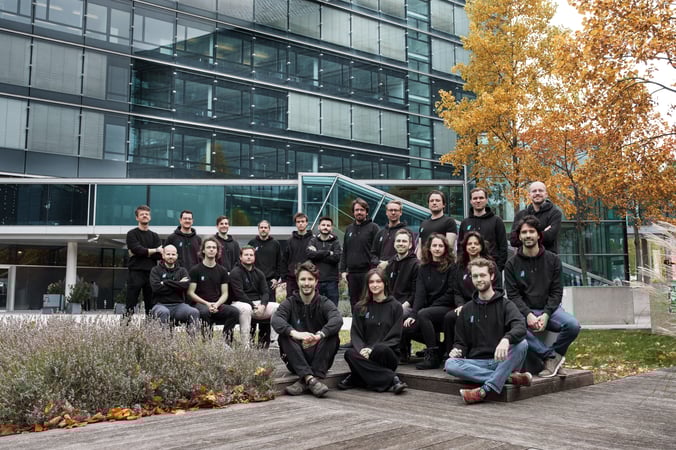
The products and technologies developed by GATE Space offer potential for additional applications. The company’s goal is to provide its customers with flexible maneuvering capabilities for their satellites in space – whether for interplanetary missions, to autonomously avoid collisions, or for the now mandatory deorbiting of old satellites. Moritz Novak: “We are excited about the future. Technological advances in mobility have always changed the world – from the wheel to the steam engine to automation. We look forward to advancing mobility in space

The 21-member GATE Space Team is working on mobility in space. | © GATE Space
Simulations are indispensable to our approach. They enable us to design prototypes optimally right from the start.
CADFEM meets Moritz Novak
In this interview (DE), Moritz Novak, founder and CEO of GATE Space, offers further insights into the start up, its challenges, and its goals. He also explains how the space industry of today (“New Space”) differs from that of the past (“Old Space”).